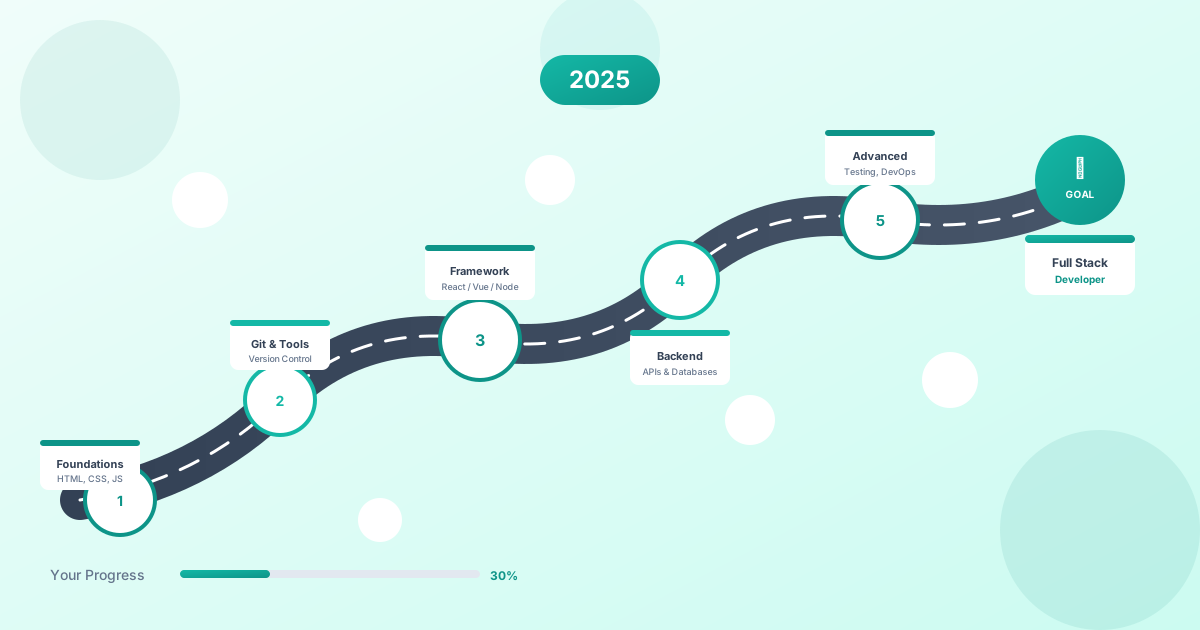
Learning to code in 2025 opens doors to countless opportunities—from high-paying tech careers to building your own products. But with hundreds of languages, frameworks, and learning resources available, knowing where to start can feel overwhelming.
This comprehensive roadmap will guide you from complete beginner to job-ready developer, with specific paths based on your goals.
Before You Start: Choosing Your Path
The first question isn’t “which programming language should I learn?” It’s “what do I want to build?”
Your goal determines your path:
| Goal | Recommended First Language | Focus Area |
|---|---|---|
| Web Development | JavaScript | Frontend or Full-Stack |
| Mobile Apps | JavaScript (React Native) or Swift/Kotlin | Cross-platform or Native |
| Data Science | Python | Data Analysis, ML |
| Game Development | C# (Unity) or C++ | Game Engines |
| Automation/Scripting | Python | Scripts, Tools |
| Enterprise Software | Java or C# | Backend Systems |
Don’t have a specific goal yet? Start with Python or JavaScript—they’re versatile, beginner-friendly, and in high demand.
Phase 1: Programming Fundamentals (4-8 weeks)
Before diving into any specific technology, master the fundamentals that apply to all programming.
Core Concepts to Learn
1. Variables and Data Types Understanding how to store and manipulate data is the foundation of everything.
- Numbers, strings, booleans
- Arrays and lists
- Objects and dictionaries
2. Control Flow How programs make decisions and repeat actions.
- If/else statements
- Loops (for, while)
- Switch/case statements
3. Functions Breaking code into reusable pieces.
- Defining and calling functions
- Parameters and return values
- Scope and closures
4. Basic Data Structures Organizing data efficiently.
- Arrays and lists
- Objects/dictionaries
- Sets and maps
5. Problem-Solving Patterns Thinking like a programmer.
- Breaking problems into steps
- Pattern recognition
- Debugging techniques
Learning Approach for Phase 1
- Week 1-2: Variables, data types, basic operators
- Week 3-4: Control flow and loops
- Week 5-6: Functions and basic data structures
- Week 7-8: Practice problems and mini-projects
Key Milestone: Build a simple command-line program (calculator, to-do list, or quiz game).
Phase 2: Choose Your Specialization
After fundamentals, pick a path based on your goals:
Path A: Web Development (Most Popular)
Web development has the lowest barrier to entry and highest job demand. You can see results immediately in your browser.
Frontend Development Stack:
- HTML & CSS (2-3 weeks)
- JavaScript fundamentals (already done in Phase 1)
- DOM manipulation (1-2 weeks)
- A frontend framework - React recommended (4-6 weeks)
- CSS framework - Tailwind CSS (1-2 weeks)
Backend Development Stack:
- Node.js and Express (3-4 weeks)
- Databases - PostgreSQL or MongoDB (2-3 weeks)
- APIs and REST principles (2 weeks)
- Authentication and security basics (1-2 weeks)
Full Timeline: 4-6 months for frontend, 6-9 months for full-stack
Path B: Data Science & Machine Learning
If you’re fascinated by data analysis, statistics, and making predictions from data.
Core Stack:
- Python fundamentals (already done in Phase 1)
- NumPy and Pandas (3-4 weeks)
- Data visualization - Matplotlib, Seaborn (2 weeks)
- Statistics and probability (3-4 weeks)
- Machine Learning basics - Scikit-learn (4-6 weeks)
- Deep Learning introduction - TensorFlow or PyTorch (4-6 weeks)
Full Timeline: 6-9 months to job-ready data analyst
Path C: Mobile Development
Building apps for iOS and Android.
Cross-Platform (Recommended for beginners):
- JavaScript fundamentals (Phase 1)
- React basics (3-4 weeks)
- React Native (6-8 weeks)
- Mobile-specific patterns (navigation, storage, etc.)
Native Development:
- iOS: Swift and SwiftUI
- Android: Kotlin and Jetpack Compose
Full Timeline: 4-6 months for cross-platform, longer for native
Path D: Game Development
Creating games for entertainment or serious applications.
Recommended Stack:
- C# fundamentals (4-6 weeks)
- Unity game engine basics (4-6 weeks)
- 2D game development (4-6 weeks)
- 3D game development (4-6 weeks)
- Game design principles (ongoing)
Full Timeline: 6-12 months for a portfolio-ready game
Phase 3: Building Projects (Ongoing)
Theory without practice produces weak developers. Projects cement your learning and build your portfolio.
Project Progression
Beginner Projects (1-2 weeks each):
- Personal portfolio website
- To-do list application
- Weather app using an API
- Simple blog or notes app
Intermediate Projects (2-4 weeks each):
- Full-stack CRUD application
- Social media clone (simplified)
- E-commerce store
- Real-time chat application
Advanced Projects (1-2 months each):
- SaaS application with authentication
- Mobile app with backend
- Data dashboard with visualizations
- Contribution to open source
Project Tips
- Build what interests you. You’ll learn more from a project you care about.
- Complete projects fully. A finished simple project beats an unfinished complex one.
- Add features incrementally. Start simple, then add complexity.
- Document your work. Write READMEs and explain your decisions.
Phase 4: Professional Skills
Technical skills alone won’t get you hired. Develop these complementary abilities:
Version Control with Git
Every professional developer uses Git. Learn:
- Basic commands (init, add, commit, push, pull)
- Branching and merging
- Collaboration workflows
- GitHub/GitLab basics
Timeline: 1-2 weeks for basics, ongoing mastery
Command Line Proficiency
Comfort with the terminal is essential.
- File system navigation
- Running scripts and programs
- Package managers (npm, pip)
- Basic shell commands
Timeline: 1-2 weeks, practice regularly
Development Tools
- Code editors (VS Code recommended)
- Browser developer tools
- Debugging techniques
- Testing basics
Soft Skills
- Reading documentation
- Asking good questions
- Code review etiquette
- Technical communication
Phase 5: Getting Your First Job
When you’re job-ready:
Portfolio Requirements
Minimum for entry-level positions:
- 3-5 quality projects on GitHub
- Live deployed applications
- Clean, documented code
- A personal website/portfolio
Application Strategy
- Tailor your resume for each application
- Network actively - LinkedIn, meetups, Twitter/X
- Apply strategically - quality over quantity
- Practice interviewing - LeetCode for algorithms, mock interviews for behavioral
Interview Preparation
Technical interviews typically include:
- Algorithm and data structure problems
- System design (for senior roles)
- Take-home projects
- Pair programming sessions
Behavioral interviews assess:
- Problem-solving approach
- Communication skills
- Teamwork and collaboration
- Learning ability
Realistic Timelines
| Starting Point | Goal | Realistic Timeline |
|---|---|---|
| Complete beginner | Junior frontend developer | 6-9 months |
| Complete beginner | Junior full-stack developer | 9-12 months |
| Complete beginner | Junior data analyst | 6-9 months |
| Some coding experience | Junior developer | 3-6 months |
These timelines assume 15-20 hours per week of focused learning.
Common Mistakes to Avoid
Tutorial Hell
Watching tutorials endlessly without building. After learning a concept, immediately apply it in a project—even a small one.
Shiny Object Syndrome
Jumping between languages and frameworks without mastering any. Pick a path and stick with it until you’re competent.
Perfectionism
Waiting until you “know enough” to start building or applying for jobs. You’ll never feel ready. Start before you’re ready.
Isolation
Learning alone without community. Join Discord servers, attend meetups, find study partners. Programming is more collaborative than it seems.
Ignoring Fundamentals
Rushing to frameworks without solid fundamentals. This creates knowledge gaps that become problems later.
Resources for Each Phase
Free Resources
Learning Platforms:
- freeCodeCamp - Web development curriculum
- The Odin Project - Full-stack web development
- Codecademy - Interactive lessons
- Khan Academy - Computer science basics
Documentation & References:
- MDN Web Docs - Web technologies
- Official language documentation
- Stack Overflow - Problem-solving
YouTube Channels:
- Traversy Media - Web development
- Fireship - Quick tech explanations
- Corey Schafer - Python tutorials
Paid Resources (When Ready)
- Frontend Masters - Deep dives into web technologies
- Udemy - Affordable courses (buy on sale)
- Pluralsight - Enterprise-focused content
- Scrimba - Interactive coding courses
Your Personalized Path Forward
This roadmap provides a general framework, but the best learning path is personalized to:
- Your specific goals and interests
- Your available time and schedule
- Your existing knowledge and skills
- Your learning style and pace
Generic roadmaps can’t account for these individual factors. That’s why many learners benefit from customized curricula that adapt to their unique situation.
Key Takeaways
- Choose your goal first, then select technologies that support it
- Master fundamentals before specializing
- Build projects constantly - they’re your best teachers
- Stay consistent - regular practice beats occasional marathons
- Connect with community - learning together accelerates growth
- Be patient - programming is a marathon, not a sprint
The journey from beginner to professional programmer is challenging but achievable. Thousands of people make this transition every year. With the right approach, you can too.
Want a personalized programming roadmap? Solohustller creates custom learning paths based on your goals, schedule, and experience level. Skip the generic advice and get a curriculum designed specifically for you. Start free today.