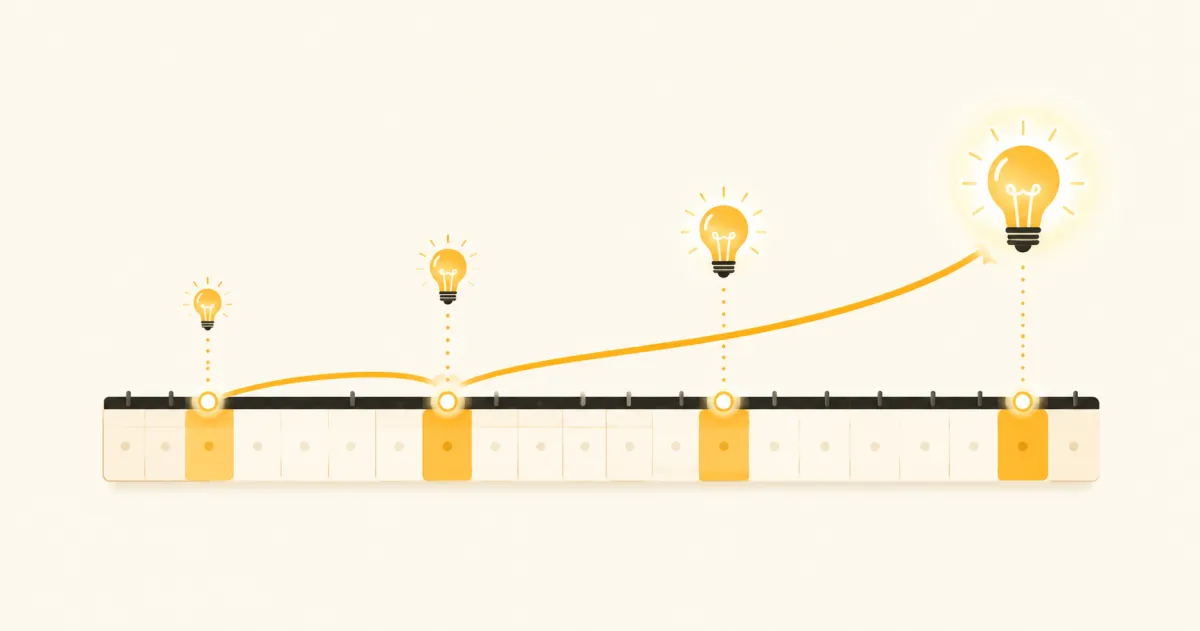
A personalized learning plan is a written roadmap that defines your goal, measures your current level, sequences what to learn in order, fits the work to your real schedule, and tracks progress against checkpoints. Building one takes five steps: set the goal, assess where you stand, map the path, budget your time, and add progress checkpoints.
Most people who set out to learn a new skill start in the wrong place. They pick a course, buy a book, or bookmark a dozen tutorials, then wonder why they stall out three weeks later. The problem is not effort or intelligence. It is the absence of a plan built around you — your goal, your starting point, and the hours you can actually spare.
A personalized learning plan fixes that. It replaces guesswork with a clear, ordered path that adapts to your situation instead of forcing you into a generic curriculum built for the average learner who does not exist. This guide walks through exactly how to create one, step by step.
What a Personalized Learning Plan Includes
Before you build one, it helps to know what a complete personalized learning plan actually contains. Unlike a random list of resources, a real plan has structure. It answers five questions:
- Where am I going? A specific goal with a clear finish line.
- Where am I now? An honest assessment of your current level.
- What is the path? An ordered sequence of topics and skills, from foundation to fluency.
- How much time do I have? A realistic schedule that fits your life.
- How will I know I am on track? Checkpoints and progress markers.
A plan missing any one of these tends to fall apart. Skip the goal and you wander. Skip the assessment and you either bore yourself with basics or drown in material above your level. Skip the sequence and you learn things in an order that makes each concept harder than it needs to be. Skip the schedule and the plan never survives contact with a busy week. Skip the checkpoints and you have no way to tell progress from motion.
A good personalized learning plan is also a living document. You will revise it as you learn more about the subject and about how you learn best. Think of it as a working map, not a stone tablet.
Step 1 — Define the Goal and the “Done” Line
Every strong learning plan starts with a goal specific enough to be finished. “Get better at design” is not a goal. “Build three polished portfolio pieces and be able to take on a paid freelance logo project” is.
The key is defining your “done” line — the observable point at which you can say the goal is achieved. A done line is concrete and external. You should be able to point at it and know, without arguing with yourself, whether you have reached it.
Here are weak goals rewritten with clear done lines:
- Weak: “Learn Python.” Strong: “Write a program that scrapes a website and saves the data to a spreadsheet, without looking up the basic syntax.”
- Weak: “Get fit in the market.” Strong: “Pass a mock data analyst interview and complete two portfolio dashboards.”
- Weak: “Understand marketing.” Strong: “Run a small ad campaign end to end and report on what it cost per result.”
A sharp goal does double duty. It tells you what to include in your plan, and just as importantly, what to leave out. Most learners fail not because they study too little but because they try to learn everything. A clear done line gives you permission to ignore the 80 percent of a subject you do not need yet.
If your goal feels too big to define cleanly, that is a signal to narrow it. You can always set a second goal later. For a deeper framework on turning ambitions into achievable targets, the process of creating a learning schedule you actually stick to pairs naturally with goal-setting.
Step 2 — Assess Your Current Level
The same course can be perfect for one person and useless for another. The difference is starting point. Step two is an honest inventory of what you already know so your plan begins at the right place — not too basic, not over your head.
You do not need a formal test. A quick self-assessment works. Ask yourself three questions about your target skill:
- What can I already do without help? List the tasks you can complete start to finish today.
- What do I half-know? Note the areas you have seen but cannot yet do reliably. These are your quick wins.
- What is completely new? Everything left is where the bulk of your learning time will go.
Be careful of two traps. The first is overestimating — assuming that because a topic looks familiar, you have mastered it. Familiarity is not skill. If you cannot do it from a blank page, it belongs in your plan. The second is underestimating — restarting from zero out of a lack of confidence and wasting weeks on material you already own.
A good test for any topic: can you explain it to someone else, or produce it without a reference? If yes, skip it. If no, it stays in the plan. This honest baseline is one of the signs you need a personalized learning path rather than a fixed course — because a fixed course assumes everyone starts in the same spot, and no one does.
Step 3 — Map the Path and Sequence It
Now you connect where you are to where you want to be. This is the heart of a personalized learning plan: laying out every topic between your current level and your done line, then putting them in the right order.
Sequence matters more than most learners realize. Concepts build on each other. Learn them out of order and each new idea feels harder than it should, because you are missing the foundation it rests on. Learn them in the right order and each topic makes the next one easier.
Work backward from the goal
Start at your done line and ask, “What must I know to do this?” Then ask the same question of each answer. Keep going until you reach topics you already have from Step 2. You have now mapped the full dependency chain — and reading it forward gives you your sequence.
For example, a data dashboard depends on cleaning data, which depends on basic query skills, which depend on understanding what your data represents. Read forward, and your path is clear: data basics, then queries, then cleaning, then visualization.
Group topics into phases
A flat list of thirty topics is intimidating. Group them into three or four phases, each with a mini-milestone:
- Phase 1 — Foundations: the core concepts everything else needs.
- Phase 2 — Core skills: the working abilities that make up most of the job.
- Phase 3 — Application: projects that combine skills into real output.
- Phase 4 — Specialization: the specific direction your goal points toward.
Sequencing is exactly where generic courses fall short. They are built for a hypothetical median student, so they either repeat what you know or skip what you do not. That mismatch is a big reason generic online courses do not work for self-directed learners with a specific goal.
Step 4 — Fit It to Your Time Budget
A plan you cannot sustain is not a plan — it is a wish. Step four is where you take your sequenced path and press it against the hard limit of your calendar.
Start by finding your honest weekly hours. Not the hours you wish you had, but the ones that actually exist after work, sleep, and life. For most people learning around a job, that is somewhere between three and eight hours a week. Whatever it is, use the real number.
Then do the math. If your mapped path holds roughly 60 hours of material and you have 5 hours a week, you are looking at about 12 weeks. Suddenly the abstract goal has a timeline. That timeline is one of the most motivating things a plan can give you, because it turns “someday” into “by August.”
A few rules keep this realistic:
- Prefer short, frequent sessions over long, rare ones. Four 45-minute sessions beat one 3-hour cram, both for retention and for actually showing up.
- Protect a fixed slot. Attaching study to an existing anchor in your day — after morning coffee, before dinner — removes the daily decision of when.
- Build in slack. Assume you will miss one session a week. A plan with no margin breaks the first busy week.
- Size lessons to the slot, not the other way around. If you have 30-minute windows, your material should come in 30-minute pieces.
If time is your real constraint — and for most self-directed learners it is — then the biggest lever you have is fitting the work to your schedule instead of hoping your schedule bends to the work. This is exactly where a personalized learning approach earns its keep: a plan paced to five real hours a week will always beat an ambitious plan paced to fifteen hours you do not have.
Step 5 — Add Checkpoints and Track Progress
The final step is what separates a plan that finishes from one that quietly dies: checkpoints and visible progress. Without them, you cannot tell whether you are moving forward or spinning your wheels — and uncertainty is where motivation goes to die.
Checkpoints are the moments where you prove to yourself that a phase actually stuck. A checkpoint is not “I watched the videos.” It is “I can do the thing.” Build one at the end of each phase from Step 3:
- End of Phase 1: a short quiz or a from-scratch exercise on the foundations.
- End of Phase 2: a small project using the core skills.
- End of Phase 3: a portfolio-worthy piece.
- End of Phase 4: something that matches your done line.
Progress tracking is the running record between checkpoints. Something as simple as marking each completed session on a calendar creates a visible chain, and the desire not to break that chain is one of the most reliable motivators there is. Watching the completed portion of your path grow week over week supplies the sense of momentum that keeps people going long after the initial excitement fades.
Checkpoints also tell you when to adjust. If you consistently fail a phase’s checkpoint, the plan is telling you to slow down or add a prerequisite. If you breeze through, you can compress. A plan that responds to this feedback stays personalized over time instead of drifting back toward a generic schedule.
Doing It Manually vs Letting It Be Built for You
You can absolutely build a personalized learning plan by hand using the five steps above, and the discipline of mapping it yourself teaches you a lot about the subject before you start.
But it has a catch: to sequence a subject correctly, you often need to already understand it. A beginner mapping a path through an unfamiliar field is guessing at dependencies they cannot yet see. That is the paradox of self-directed learning — the sequencing decision that matters most is the one you are least equipped to make on day one.
That is where a tool that generates the plan for you changes the equation. Instead of guessing the order of topics, you supply the three inputs you can provide — your goal, your current level, and your weekly hours — and receive a sequenced path built around them.
Here is a quick comparison:
| Building it manually | Having it built for you | |
|---|---|---|
| Sequencing | You guess the order, often before you understand the field | The path is ordered by dependency for you |
| Time cost | Hours of research before you start learning | Minutes to set up |
| Adjusting | You re-plan by hand when something changes | The path re-sequences as you progress |
| Best for | Subjects you already partly know | New fields where you cannot see the dependencies |
Neither approach is wrong. If you know a field well enough to sequence it, doing it by hand is satisfying and free. Starting cold in an unfamiliar subject, having the plan built for you removes the exact obstacle most likely to stall you before you begin.
Frequently Asked Questions
What is a personalized learning plan?
A personalized learning plan is a structured roadmap tailored to one learner’s specific goal, current skill level, and available time. It defines a clear finish line, sequences topics in the order that makes each one easier to learn, fits the workload to a real schedule, and includes checkpoints to track progress. It differs from a generic course by starting from where you are rather than from a one-size-fits-all curriculum.
How long does it take to create a personalized learning plan?
Building a basic plan by hand takes one to three hours: roughly 20 minutes to define the goal and done line, 20 minutes to assess your level, an hour to map and sequence the topics, and the rest to fit it to your schedule and add checkpoints. Tools that generate a sequenced plan from your goal, level, and time budget can produce one in minutes.
What should a personal learning plan include?
A complete personal learning plan includes five elements: a specific goal with a measurable “done” line, an honest assessment of your current level, an ordered sequence of topics from foundation to mastery, a realistic weekly time budget, and checkpoints that verify each phase before you move on. Missing any one of these is the most common reason plans fall apart.
How is a personalized learning plan different from a study schedule?
A study schedule answers when you will learn; a personalized learning plan answers what, in what order, and how you will know it worked. The schedule is one part of the larger plan — specifically Step 4. A plan without a schedule never gets executed, and a schedule without a plan has nothing meaningful to fill the time slots with.
Can I create a learning plan for any skill?
Yes. The five-step process works for technical skills like programming or data analysis, creative skills like design or writing, and knowledge-based subjects like a new language. The steps stay the same; only the specific topics and sequence change. The harder the field is to sequence on your own, the more a personalized approach helps — because ordering matters most exactly where you can see it least.
How often should I update my learning plan?
Review your plan at each phase checkpoint, and adjust whenever your available time changes or a checkpoint reveals a gap. A plan is a working document, not a contract. Consistently failing a checkpoint means slow down or add a prerequisite; consistently breezing through means you can compress the timeline.
Build Your Plan Without the Guesswork
You now have the full five-step method for creating a personalized learning plan: define the goal, assess your level, map and sequence the path, fit it to your time, and track progress with checkpoints. Follow it and you will have something most learners never do — a clear, ordered path built around your real situation.
If you would rather skip the hardest part — sequencing an unfamiliar subject you cannot yet see the shape of — Solohustller does exactly this job for you. You enter your goal, your current level, and the hours you can spare each week, and Solohustller produces the full sequenced plan: structured daily lessons paced to your schedule, quizzes that confirm each concept sticks before you move on, milestone checkpoints, and progress tracking that shows precisely where you stand on the path to your goal. It is personalized learning built around you, not a fixed library made for everyone.
Ready to turn your goal into a day-by-day plan you will actually finish? Join the Solohustller waitlist and get a learning path built around your level, your schedule, and where you want to end up.