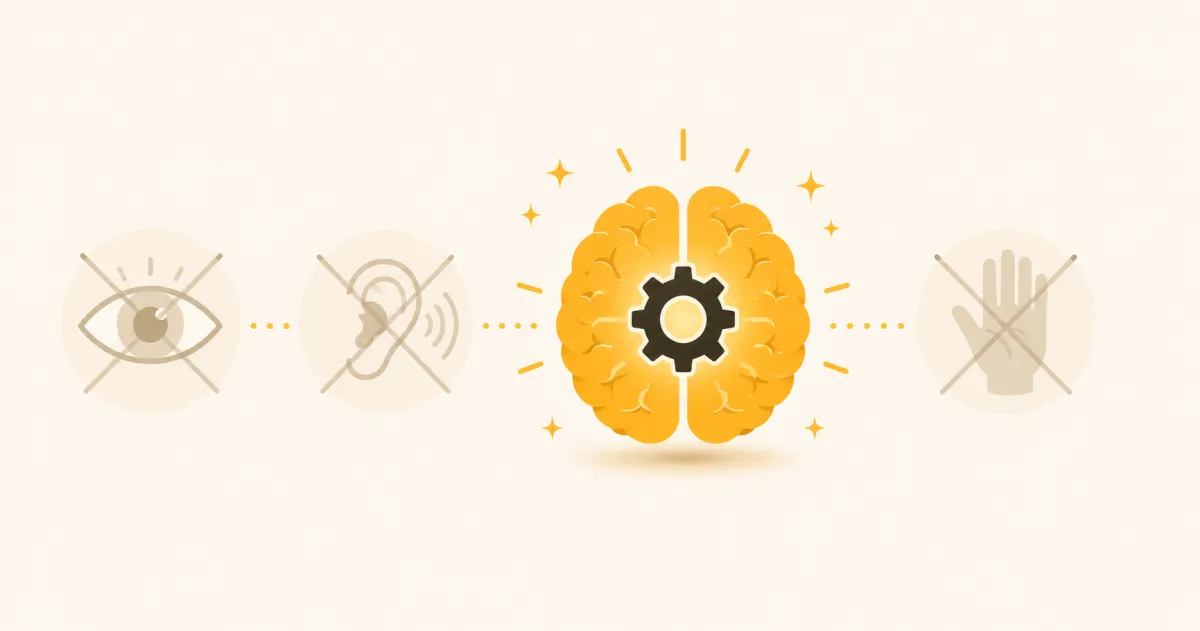
Learning styles are a myth. Decades of research show no benefit to matching instruction to a “visual,” “auditory,” or “kinesthetic” style. What actually drives learning is your prior knowledge, the format that fits the material, and effortful practice through recall and spaced review — not a fixed personal style.
You have probably heard it before. Maybe a teacher told you that you are a “visual learner,” or an online quiz sorted you into the “auditory” or “hands-on” category. The idea feels intuitive and even flattering. It suggests that if you could just find your one true style, learning would finally click.
The problem is that this comforting idea does not hold up. When researchers put learning styles to the test, the results are strikingly consistent: matching lessons to a supposed style does not improve learning. Believing the myth can even hurt you, because it steers your attention toward the wrong things. The good news is that the techniques that genuinely work are well documented, simple to apply, and available to everyone regardless of “style.”
Let us break down where the learning styles idea came from, why science does not support it, and what to do instead.
The Learning Styles Theory, Explained
The learning styles theory claims that each person has a preferred sensory channel for taking in information, and that teaching to that channel improves how much they learn. The most popular version is the “VARK” model, which sorts people into four types.
- Visual learners are said to learn best from diagrams, charts, and images.
- Auditory learners supposedly absorb more from lectures, discussions, and audio.
- Reading/writing learners are described as preferring text, lists, and notes.
- Kinesthetic learners are said to need hands-on, physical practice.
The theory has spread far beyond a single model. By some counts, there are more than 70 different learning styles frameworks in circulation. Surveys consistently find that the vast majority of educators — often around 90 percent — believe people learn better when taught in their preferred style.
Here is the key distinction that gets lost. Almost everyone has genuine preferences. You might enjoy a video more than a textbook, or find a podcast easier to sit through than an article. That preference is real. What the theory adds — and what turns out to be false — is the claim that teaching to your preference makes you learn more. Liking a format and learning better from it are two different things.
Why Science Doesn’t Support Learning Styles
To test the learning styles theory properly, researchers use what is called the “meshing hypothesis.” The logic is straightforward: if styles are real, then people taught in their matching style should outperform people taught in a mismatched style. A visual learner given visual instruction should beat a visual learner given auditory instruction.
When studies are designed this way, the effect disappears.
A landmark 2008 review in Psychological Science in the Public Interest examined the evidence and found almost no rigorous studies supporting the meshing hypothesis — and the few well-designed experiments that existed contradicted it outright. The authors concluded there was no adequate scientific basis for using learning styles in education. Later experiments reached the same verdict. Assessing students’ styles and then matching or mismatching instruction produced no meaningful difference in what they retained.
There is a deeper reason the theory fails. Most knowledge is not stored by sensory channel — it is stored by meaning. When you learn what a “peninsula” is, you do not file it under “things I saw” or “things I heard.” You understand the concept. The best format for teaching it depends on the idea itself, not on you. A map is the right tool for teaching geography for everyone, and a rhythm is the right tool for learning a song for everyone.
This is why the learning styles myth can quietly hold you back. If you decide you are “not a reading person,” you may avoid text-heavy material that a subject genuinely requires. If you label yourself “visual,” you might skip the effortful practice that actually builds skill in favor of passively watching videos that feel productive but teach little. The label becomes a limit.
What Actually Determines How Well You Learn
If style is not the lever, what is? Research points to a handful of factors that reliably shape how well and how fast you learn. These are the things worth your attention.
Prior Knowledge
The single strongest predictor of how easily you learn something new is how much you already know about it. New information sticks when it can attach to something already in your memory. This is why an experienced cook picks up a new recipe in seconds while a beginner struggles through every step.
The practical takeaway is powerful: instead of hunting for your “style,” invest in fundamentals. Building a solid base in a subject makes everything that follows easier to absorb. Learning compounds. The more you know, the faster you learn the next thing — which is exactly why a path that starts at your real level beats one that assumes too much or too little.
Matching Format to the Material (Not the Person)
The format that works best is determined by what you are learning, not who you are.
- Learning to pronounce a new language? You need audio, for everyone.
- Understanding how blood flows through the heart? A diagram or animation wins, for everyone.
- Mastering a tennis serve? You have to physically practice it, for everyone.
Good learning uses whatever format the material demands, and it usually combines several. A well-designed lesson on the water cycle might pair a diagram with a written explanation and a short exercise — not because you are one “type,” but because the concept is richer when approached from multiple angles. This is a core reason generic online courses so often fall flat: they lock into one format for a whole catalog of very different topics.
Effortful Practice
Learning that feels easy is often learning that does not last. The techniques that produce durable memory tend to feel harder in the moment — a phenomenon researchers call “desirable difficulty.” When you struggle to retrieve an answer, wrestle with a problem, or explain an idea in your own words, you are building stronger, more lasting connections.
This is the opposite of what the learning styles myth encourages. Watching a video in your “preferred” style feels smooth and pleasant, which tricks you into thinking you are learning. But the effort you avoid is precisely the effort that makes knowledge stick.
Evidence-Based Techniques That Beat “Style Matching”
Instead of sorting yourself into a category, put your energy into methods that decades of cognitive science have shown to work. These apply to every subject and every person.
-
Active recall. Test yourself instead of re-reading. Close the book and try to retrieve what you just studied. Retrieval practice is one of the most powerful learning tools ever measured — far more effective than passive review. If you want the full method, see our guide to active recall as a study technique.
-
Spaced repetition. Review material across increasing intervals — a day later, a few days later, a week later — rather than cramming it all at once. Spacing fights the natural forgetting curve and locks knowledge into long-term memory.
-
Interleaving. Mix related topics or problem types in a single study session instead of drilling one thing to exhaustion. It feels harder, but it dramatically improves your ability to tell concepts apart and apply the right one at the right time.
-
Elaboration. Ask why and how, and connect new ideas to things you already know. Explaining a concept in your own words — as if teaching someone else — exposes gaps and deepens understanding.
-
Concrete examples. Anchor abstract ideas to specific, vivid examples. A definition alone is fragile; a definition plus two or three good examples is far more likely to stay with you.
-
Dual coding. Combine words with visuals. This is not about being a “visual learner” — pairing a clear diagram with a clear explanation helps everyone because it gives the brain two complementary ways to encode the same idea.
Notice what these techniques have in common. None of them ask about your style. They ask you to engage actively with the material, space out your effort, and embrace a bit of difficulty. That is where real learning lives.
How to Personalize Learning the Right Way
Here is the twist that surprises people. Rejecting learning styles does not mean rejecting personalization. It means personalizing based on things that actually matter instead of a mythical style.
Real, evidence-aligned personalization adapts to:
- Your goal. Learning Spanish for a trip is a different path than learning it for a professional certification. The destination shapes the route.
- Your current level. Because prior knowledge is the biggest driver of learning, the most valuable personalization is starting you at the right point — not too basic, not over your head.
- Your available time. A plan you can actually sustain beats an ambitious one you abandon. Fitting learning to your real schedule is what keeps you consistent, and consistency is what compounds. Our guide to building a learning schedule you’ll stick to digs into this.
- Your pace and progress. Moving forward only once a concept sticks — confirmed through recall, not a gut feeling — prevents the shaky foundations that make later material feel impossible.
This is the meaningful sense of “learning your way.” Not a fixed sensory label stamped on you at birth, but a path shaped by your actual goal, starting point, and life. If you have felt that off-the-shelf courses never quite fit, that instinct is worth listening to — here are five signs you need a personalized learning path.
A well-built personalized learning experience puts this into practice automatically. Rather than asking whether you are visual or auditory, it asks what you want to achieve, how much you already know, and how much time you have — then sequences proven techniques like recall and spaced review into the path itself. That is personalization grounded in evidence, not in a myth.
Frequently Asked Questions
Are learning styles real?
No. While people have genuine preferences for how they receive information, rigorous research shows that matching instruction to a preferred “style” does not improve learning. A 2008 review in Psychological Science in the Public Interest found no adequate scientific evidence for the theory, and later experiments have consistently reached the same conclusion.
If I’m a visual learner, why do videos help me more than reading?
You likely find videos more enjoyable or easier to sit through, which is a real preference. But enjoying a format is not the same as learning more from it. For many topics, a diagram or animation genuinely is the best format — for everyone, not just “visual learners.” The right format depends on the material, not on a personal style.
Does believing in learning styles cause any harm?
It can. Labeling yourself as one type may lead you to avoid formats a subject actually requires, or to lean on passive methods that feel comfortable but teach little. It can also become a self-imposed ceiling, convincing you that you “can’t” learn certain things in certain ways when the real issue is method, not style.
What should I do instead of finding my learning style?
Focus on techniques proven to work for everyone: active recall (testing yourself), spaced repetition (reviewing over time), interleaving (mixing topics), and elaboration (explaining ideas in your own words). Build strong fundamentals first, since prior knowledge is the biggest driver of how fast you learn.
What is the difference between a learning preference and a learning style?
A preference is simply the format you enjoy or find comfortable. A “style,” as the theory claims it, is a fixed trait that supposedly makes you learn better when instruction matches it. Preferences are real and harmless. The style claim — that matching improves learning outcomes — is the part that research does not support.
Is personalized learning also a myth, then?
No. Personalized learning is real and effective when it adapts to things that genuinely matter: your goal, your current knowledge level, your available time, and your pace. What is a myth is personalizing around sensory “styles.” Personalization based on your actual starting point and objectives is well supported.
Learn the Way That Actually Works — With Solohustller
Once you let go of the learning styles myth, a better question takes its place: how do you build a path around the things that truly move the needle? That is exactly what Solohustller is designed to do.
Instead of sorting you into a sensory type, Solohustller builds a structured learning path around your real goal, your current level, and the time you can commit. Proven techniques are woven into the experience by default — quizzes prompt active recall so you retrieve knowledge instead of passively re-reading, review is spaced across your path so material actually sticks, and progress tracking shows you exactly where you stand so you advance only once a concept holds.
That is personalization grounded in learning science, not folklore. You do not have to assemble the right methods yourself or guess where to start — the path does that for you, one manageable step at a time.
Ready to learn based on what works instead of what you were once told? Join the Solohustller waitlist and get a learning path built around your goals, your level, and your schedule.