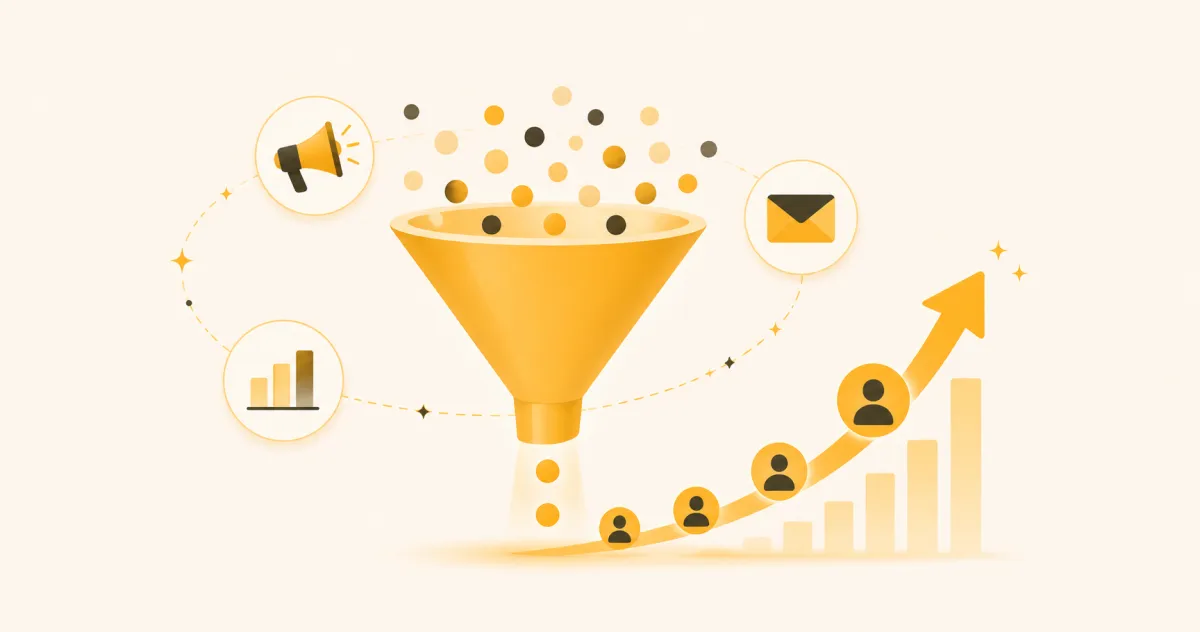
To learn digital marketing from scratch, master one sub-skill at a time in a deliberate order: start with SEO and content, then analytics and paid ads, then email and social. Practice on a real or simulated project after each stage, and build a portfolio of results. Most beginners reach job-ready in six to nine months.
Digital marketing looks intimidating from the outside. Search “how to learn digital marketing” and you get a wall of conflicting advice, hundreds of tools, and a dozen sub-fields that all sound essential. The good news is that you do not need a degree, an agency job, or an expensive bootcamp to break in. Digital marketing is one of the most self-teachable, high-demand skills available in 2026, and the path is more predictable than most people assume.
This guide breaks the field into clear stages, tells you what to learn first, and gives you a realistic timeline to your first paid work. Follow it in order and you avoid the single biggest mistake beginners make: trying to learn everything at once and mastering nothing.
What “Digital Marketing” Actually Covers
Before you learn digital marketing, you need to understand what the term really means. “Digital marketing” is not one skill. It is an umbrella covering every way a business attracts and converts customers online.
At its core, digital marketing is about three things: getting the right people to notice a product, persuading them to act, and measuring whether it worked. Every sub-discipline serves one of those goals.
Here is the landscape at a glance:
- Search engine optimization (SEO): earning free, organic traffic from Google and other search engines.
- Content marketing: creating articles, videos, and guides that attract and build trust with an audience.
- Paid advertising (PPC): buying traffic through platforms like Google Ads and Meta Ads.
- Email marketing: nurturing leads and customers through their inbox.
- Social media marketing: building reach and engagement on platforms like Instagram, LinkedIn, TikTok, and X.
- Analytics: measuring performance so you know what to keep, cut, or scale.
You do not need to master all of these to get hired. Most working marketers specialize in one or two and stay conversational in the rest. Your job as a beginner is to build a solid foundation across the field, then go deep where the demand and your interest overlap. This is a theme worth remembering from our guide to 12 high-income skills you can learn on your own in 2026: breadth first, then depth.
The Sub-Skills and Where to Start
The most common beginner failure is picking a random tutorial and drowning. The fix is sequencing. Learn the sub-skills in an order where each one builds on the last, so nothing feels arbitrary.
SEO and Content
Start here. SEO and content marketing are the best entry point for three reasons: they are free to practice, they teach you how the whole customer journey works, and the fundamentals rarely change.
Learn how search engines rank pages, how to do keyword research, and how to structure content that answers real questions. Then write. The fastest way to understand content marketing is to publish a few articles and watch how they perform. You will absorb on-page SEO, internal linking, and reader psychology far faster by doing than by watching.
Content and SEO also feed everything else. A landing page needs persuasive copy. An ad needs a headline. An email needs a hook. The writing and audience-research muscles you build here carry into every other discipline.
Paid Ads and Analytics
Once you understand organic traffic, learn to buy it. Paid advertising is where marketing gets measurable and, frankly, where a lot of the money is.
Begin with analytics, not ads. You cannot run a campaign you cannot measure. Learn to set up tracking, read a traffic report, and understand core metrics: click-through rate, conversion rate, cost per acquisition, and return on ad spend. Google Analytics and each ad platform’s built-in dashboards are your training ground.
Then learn one paid channel deeply. Google Ads is ideal for beginners because search intent is clear and results are fast. Set up a small campaign, even a $50 test, and watch how targeting, bids, and copy move the numbers. Nothing teaches paid marketing like spending real money and being forced to make it work.
Email and Social
Email and social media round out your toolkit. Email marketing is one of the highest-return channels in the field, and it is remarkably learnable: you build a list, write sequences, and measure opens and clicks. Learn segmentation, automation basics, and how to write a subject line people actually open.
Social media marketing is about consistency and platform fit. Each network rewards different content, so learn the mechanics of one or two platforms rather than spreading thin. Understand organic reach, community building, and how paid and organic social work together.
By the time you reach this stage, you will notice the sub-skills reinforcing each other. That interconnectedness is exactly why a scattered, tutorial-by-tutorial approach fails so often, a problem we cover in depth in why generic online courses don’t work.
A Step-by-Step Learning Roadmap
Here is the full sequence, stage by stage. Treat each stage as complete only when you have done the practice project, not just watched the lessons.
- Foundations (Weeks 1-3). Learn what digital marketing is, how the customer journey works, and the core vocabulary. Understand funnels, audiences, and metrics at a high level so later topics have a place to attach.
- SEO and content (Weeks 4-8). Study keyword research, on-page SEO, and content structure. Publish three to five articles on a blog you control. Track which ones rank and why.
- Analytics (Weeks 9-10). Set up tracking on your own site. Learn to read reports and connect numbers to decisions. This is your measurement backbone.
- Paid advertising (Weeks 11-15). Pick one platform, ideally Google Ads. Run a small live campaign, optimize it, and document the results.
- Email marketing (Weeks 16-18). Build a list, write a welcome sequence, and set up basic automation. Measure and improve open and click rates.
- Social media (Weeks 19-22). Choose one or two platforms. Grow a small account with organic content and, optionally, a modest paid boost.
- Specialization and portfolio (Weeks 23-26). Go deeper in the sub-skill you enjoyed most and package your projects into a portfolio.
This timeline assumes roughly 8 to 10 hours of focused study and practice per week. If you have less time, stretch it out; if you have more, compress it. What matters is the order and the practice, not hitting exact weeks.
Sequencing a broad field like this is hard to do alone. This is where a personalized learning path helps: instead of stitching together disconnected courses, you get one coherent, day-by-day plan that matches your goal and your available hours. A platform like Solohustller assembles the scattered sub-skills of marketing into a single ordered curriculum, so you always know what to learn next rather than guessing.
How Long It Takes to Land Work
The honest answer: most self-taught marketers reach job-ready in six to nine months of consistent, project-based study. Some land freelance work sooner, especially if they specialize early and build proof fast.
Your timeline depends on three factors:
- Hours per week. Ten focused hours weekly gets most people to job-ready in about six to nine months. Fewer hours means a longer runway.
- Specialization vs. breadth. Going deep in one channel, like SEO or Google Ads, can make you hireable faster than staying a generalist, because you can prove real competence in one area.
- Proof of results. Employers and clients hire evidence, not certificates. The faster you produce measurable results, the faster you get paid.
A realistic path looks like this: three to four months to build foundations across the sub-skills, another two to three months going deep in a specialty and producing results, then you start applying for junior roles, freelance gigs, or internships. Many people earn their first freelance income while still learning, which accelerates everything.
Do not wait until you feel “ready.” In marketing, real campaigns are the best teacher, and being paid to run them, even at a small scale, compresses months of learning into weeks.
Practicing on Real (or Simulated) Campaigns
Watching lessons builds familiarity. Running campaigns builds skill. The gap between the two is where most self-learners stall, so make practice non-negotiable at every stage.
You have three ways to get real reps:
- Your own project. Start a blog, a niche newsletter, or a small online store. It becomes your permanent sandbox for SEO, email, ads, and analytics. Everything you do produces real data.
- A free or discounted client. Offer to run marketing for a local business, a nonprofit, or a friend’s side project. Real stakes teach faster than any simulation, and it often turns into your first testimonial.
- Simulated campaigns. When live budgets are not an option, recreate real scenarios: audit a company’s SEO, write a mock ad campaign with targeting and copy, or build a sample email sequence. Simulations still demonstrate your thinking and process.
The point is to always be applying what you learn to something concrete. A learner who has run three real campaigns, however small, is far more hireable than one who has finished ten courses and touched nothing live. If staying consistent with this kind of hands-on practice is your struggle, our guide on how to create a learning schedule you’ll stick to will help you protect the time.
Building Proof of Skills Without Clients Yet
The classic beginner trap: you cannot get clients without experience, and you cannot get experience without clients. Break the loop by manufacturing your own proof.
Here is how to build a credible portfolio before anyone has hired you:
- Document your own projects. Your blog’s traffic growth, your newsletter’s open rates, your test ad campaign’s cost per click. Screenshot the data and write up what you did and why.
- Publish case-study breakdowns. Analyze a real brand’s marketing and explain what is working, what you would change, and what you would test. This shows strategic thinking, which employers value highly.
- Complete practice briefs. Give yourself a realistic assignment, “grow this fictional store’s email list by 20 percent,” and produce the full plan, copy, and measurement approach.
- Earn a credential that is backed by work. A certificate carries far more weight when it sits alongside the projects and results behind it.
A portfolio like this proves you can do the work, not just talk about it. For a deeper framework on packaging your work into something that gets interviews, see how to build a skills portfolio that gets you hired in 2026. The same principle applies whether you are learning marketing, design, or any self-taught skill, as our guide to learning graphic design on your own shows.
Start Your Digital Marketing Journey With Solohustller
The hardest part of learning digital marketing from scratch is not any single sub-skill. It is sequencing them into one coherent path and staying consistent long enough to get good. That is exactly the problem Solohustller is built to solve.
Instead of piecing together a dozen disconnected tutorials, you tell Solohustller your goal, your current level, and how many hours a week you can spare. It builds a structured, day-by-day learning path that orders SEO, analytics, paid ads, email, and social so each topic builds on the last. Adaptive quizzes at spaced intervals confirm each concept sticks before you move on, and progress tracking with streaks and milestones keeps momentum visible, which is the single biggest driver of consistency.
When you finish, a certificate of completion backed by your quiz history and project work gives you a credential that reflects real skill, not just attendance. It is personalized learning designed around your goal and your schedule, not a fixed video library made for everyone.
If you are ready to turn “I want to learn digital marketing” into an actionable plan, join the Solohustller waitlist and start building your tailored marketing path today.
Frequently Asked Questions
Can I learn digital marketing for free?
Yes. Most core skills, SEO, content, analytics, email, and organic social, can be learned and practiced for free using your own blog or project. The only unavoidable cost is a small budget for practicing paid advertising, and even a $50 test campaign teaches you a great deal. Structured guidance speeds things up, but the fundamentals are genuinely free to learn.
How long does it take to learn digital marketing?
Most self-taught learners reach a job-ready level in six to nine months with about 8 to 10 hours of study and practice per week. You can move faster by specializing early in one channel and producing measurable results quickly, since employers hire proof of skill over time spent.
Do I need a degree to work in digital marketing?
No. Digital marketing is one of the most skills-based fields in the job market. Employers and clients care about results and a portfolio far more than formal qualifications. A strong set of real or simulated campaigns will outperform a degree with no demonstrable work behind it.
Which digital marketing skill should I learn first?
Start with SEO and content marketing. They are free to practice, teach you how the entire customer journey works, and build the writing and audience-research skills that every other channel depends on. Once you understand organic traffic, move to analytics and then paid advertising.
Is digital marketing still a good career in 2026?
Yes. As businesses continue shifting budgets online, demand for people who can attract and convert customers digitally remains strong. Specialists in high-value channels like SEO, paid ads, and marketing analytics are especially sought after, and the field rewards self-taught practitioners who can prove results.
How do I build a portfolio with no clients?
Document your own projects, publish case-study breakdowns of real brands, and complete self-assigned practice briefs. A blog that grew its own traffic, a newsletter with real open rates, and a documented test ad campaign all serve as legitimate proof of skill that you can show before anyone has hired you.