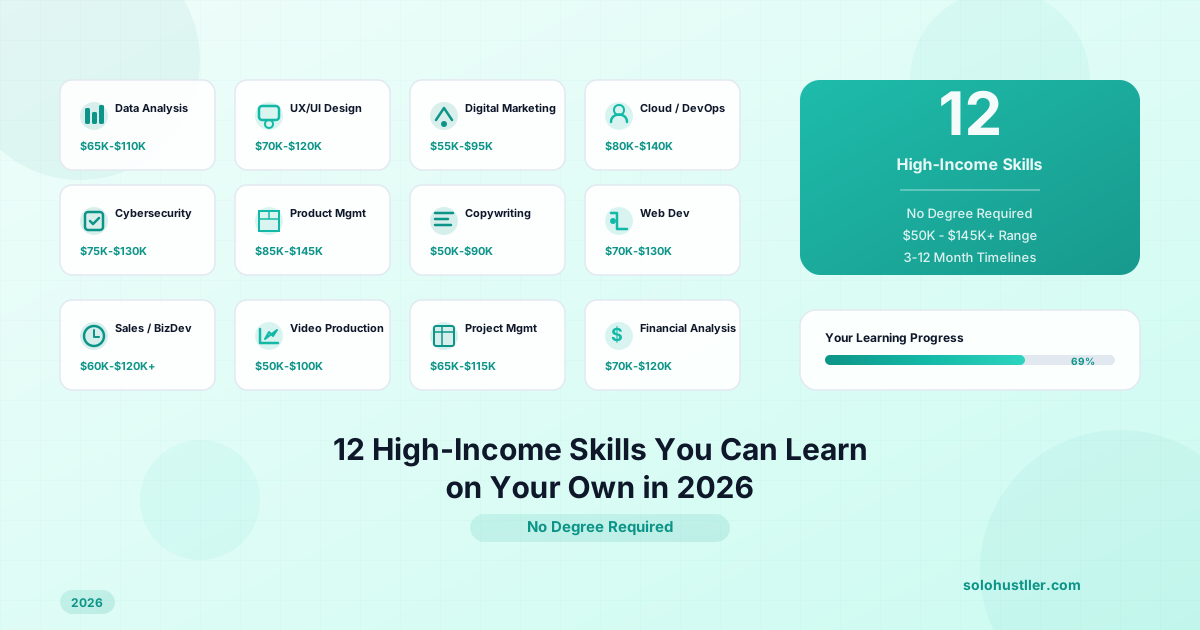
The skills gap is widening, but that is actually good news for self-taught learners. In 2026, high-income skills you can learn without a degree are more accessible and more valuable than ever before. Employers are desperate for people who can do the work, and they are finally dropping the one requirement that kept millions of capable people out: the college degree.
According to a 2025 report from the Burning Glass Institute, 53% of major employers have removed degree requirements from job listings that previously demanded them. This is not a trend. It is a structural shift in how companies hire.
You do not need a four-year degree to earn $80,000 or more per year. You need the right skills, a structured way to learn them, and proof that you can deliver results. This guide breaks down the 12 highest-paying skills you can learn on your own in 2026, with realistic timelines, clear learning paths, and a framework for actually following through.
Why Self-Taught Professionals Are in Demand in 2026
The shift toward skills-based hiring is not happening gradually. It is accelerating.
LinkedIn’s 2025 Global Talent Trends report found that skills-based hiring has increased 63% globally over the past three years. Companies are not just tolerating non-degree candidates. They are actively seeking them out.
Here is why:
- Only 28% of tech job listings now require a four-year degree, down from 46% in 2019 (CompTIA State of Tech Workforce 2025)
- 45% of hiring managers say they prioritize portfolios and demonstrated skills over diplomas (HackerRank Developer Skills Report 2025)
- 72% of Fortune 500 companies have adopted at least partial skills-based hiring practices
- The average time to fill degree-required roles is 23 days longer than equivalent skills-based roles
What does this mean for you? It means the gatekeepers are stepping aside. The question is no longer whether you can break in without a degree. It is whether you can build the right skills fast enough to take advantage of this shift.
The learners who succeed are not the ones watching random YouTube tutorials. They are the ones following personalized learning paths that match their goals, background, and schedule. Structure beats randomness every time.
The 12 High-Income Skills (with Learning Paths)
Each skill below includes a realistic salary range for the United States market, a clear learning path, a self-teaching timeline, and guidance on how to prove your competence to employers. Salary data is sourced from the Bureau of Labor Statistics, Glassdoor, and Levels.fyi for 2025-2026.
1. Data Analysis and Visualization ($65K-$110K)
Why it pays: Every company is drowning in data but starving for people who can turn numbers into decisions. Data analysts sit at the intersection of business and technology, translating raw information into clear recommendations. Demand grew 22% year-over-year in 2025.
What to learn:
- SQL for querying databases (the single most important skill)
- Excel and Google Sheets at an advanced level (pivot tables, VLOOKUP, array formulas)
- Python or R for statistical analysis
- Tableau or Power BI for creating dashboards
- Basic statistics and probability
Self-learning timeline: 4-6 months of consistent daily practice (1-2 hours per day)
How to prove it: Build a portfolio of 3-5 data analysis projects using publicly available datasets. Kaggle competitions, city open data portals, and government datasets are excellent sources. Publish your work on GitHub with clear write-ups explaining your methodology and findings.
2. UX/UI Design ($70K-$120K)
Why it pays: Companies have learned that good design is not decoration. It directly impacts revenue. A well-designed checkout flow can increase conversions by 35%. UX designers who understand both user psychology and interface design command premium salaries.
What to learn:
- User research methods (interviews, surveys, usability testing)
- Information architecture and wireframing
- Figma for interface design (the industry standard)
- Design systems and component-based thinking
- Basic HTML/CSS to communicate with developers
- Accessibility standards (WCAG)
Self-learning timeline: 5-8 months with daily practice
How to prove it: Create 3-4 detailed case studies showing your full design process, from research through final implementation. Include the problem statement, your research findings, iterations, and measurable outcomes. Publish on Behance or a personal portfolio site.
3. Digital Marketing and SEO ($55K-$95K)
Why it pays: Businesses need customers. Digital marketers who can acquire customers profitably are worth their weight in gold. The field is broad enough that you can specialize in search, paid ads, email, or content, and deep enough that experts command strong salaries.
What to learn:
- Search engine optimization (technical SEO, on-page optimization, link building)
- Google Analytics 4 and Search Console
- Paid advertising (Google Ads, Meta Ads)
- Email marketing and automation
- Content strategy and copywriting fundamentals
- Conversion rate optimization
Self-learning timeline: 3-5 months for foundational knowledge, plus ongoing practice
How to prove it: Start a blog or niche website and grow its traffic. Run a small paid ad campaign with your own money (even $100 teaches more than any course). Document your results with real analytics screenshots. Freelance for a local business to build client case studies.
4. Cloud Computing and DevOps ($80K-$140K)
Why it pays: Every company is migrating to the cloud. The demand for professionals who can build, manage, and optimize cloud infrastructure far outstrips the supply. This is one of the highest-paying skills on this list because the learning curve is steep and the stakes are high.
What to learn:
- Linux fundamentals and command line proficiency
- One major cloud platform deeply (AWS is the market leader, followed by Azure and GCP)
- Containerization with Docker and Kubernetes
- Infrastructure as Code (Terraform, CloudFormation)
- CI/CD pipelines (GitHub Actions, Jenkins, GitLab CI)
- Networking fundamentals and security basics
Self-learning timeline: 6-10 months of intensive study
How to prove it: Earn one or two cloud certifications (AWS Solutions Architect Associate is the gold standard entry point). Build and document a personal infrastructure project on GitHub. Contribute to open-source DevOps tooling.
5. Cybersecurity ($75K-$130K)
Why it pays: Cybercrime costs are projected to reach $10.5 trillion annually by 2025, according to Cybersecurity Ventures. Companies cannot hire security professionals fast enough. Entry-level security analysts can earn $75K or more, and experienced practitioners regularly exceed six figures.
What to learn:
- Networking fundamentals (TCP/IP, DNS, firewalls)
- Operating system security (Linux and Windows)
- Common attack vectors and defense strategies
- Security tools (Wireshark, Nmap, Burp Suite)
- Incident response and log analysis
- Compliance frameworks (NIST, ISO 27001)
Self-learning timeline: 6-9 months before entry-level readiness
How to prove it: Earn the CompTIA Security+ certification (widely recognized as the entry-level standard). Practice on platforms like TryHackMe and HackTheBox. Participate in Capture the Flag competitions. Document your learning journey and labs.
6. Product Management ($85K-$145K)
Why it pays: Product managers are the people who decide what gets built, and they carry direct responsibility for revenue outcomes. The role requires a rare blend of technical understanding, business acumen, and communication skills. Companies pay well because a good PM can make or break a product line.
What to learn:
- Product discovery and customer research
- Roadmap planning and prioritization frameworks (RICE, MoSCoW)
- Data-driven decision making and A/B testing
- Agile methodologies (Scrum, Kanban)
- Stakeholder management and communication
- Basic understanding of technical architecture
Self-learning timeline: 4-7 months of study combined with practical application
How to prove it: Write detailed product teardowns of existing products. Create a mock product roadmap for a company you admire. Volunteer as a product manager for an open-source project or nonprofit. Publish your thinking on product strategy through blog posts or case studies.
7. Copywriting and Content Strategy ($50K-$90K)
Why it pays: Words drive revenue. A well-written landing page can double conversion rates. A strong email sequence can generate hundreds of thousands in sales. Content strategists who understand both the creative and analytical sides of content are in constant demand.
What to learn:
- Direct response copywriting principles
- Content marketing strategy and editorial planning
- SEO writing and keyword research
- Email marketing and sequence design
- Landing page optimization
- Analytics and measuring content performance
Self-learning timeline: 3-5 months to build foundational skills
How to prove it: Build a portfolio of writing samples across different formats (landing pages, emails, blog posts, social media). Start a newsletter or blog to demonstrate consistency. Freelance for 2-3 clients to build testimonials and real-world samples.
8. Web Development, Full-Stack ($70K-$130K)
Why it pays: The web is not going anywhere. Full-stack developers who can build complete applications, from the database to the user interface, remain among the most employable professionals in technology. The salary range reflects the wide spectrum from junior to senior positions.
What to learn:
- HTML, CSS, and JavaScript fundamentals
- A modern frontend framework (React is the most in-demand, followed by Vue and Svelte)
- Backend development (Node.js, Python, or Go)
- Database design (PostgreSQL, MongoDB)
- RESTful APIs and authentication
- Version control with Git
- Deployment and hosting basics
Self-learning timeline: 6-12 months depending on prior technical experience
How to prove it: Build 3-5 complete projects, each solving a real problem. Push everything to GitHub with clean README files. Deploy your projects so employers can interact with them. Contributing to open-source projects demonstrates collaboration skills. For a structured approach to this journey, see our complete programming learning roadmap.
9. Sales and Business Development ($60K-$120K+)
Why it pays: Revenue is the lifeblood of every business. Skilled sales professionals who can consistently close deals and build client relationships earn base salaries plus commissions that regularly push total compensation past six figures. The ceiling is extremely high for top performers.
What to learn:
- Consultative selling frameworks (SPIN Selling, Challenger Sale)
- CRM tools (Salesforce, HubSpot)
- Prospecting and outbound strategy
- Negotiation and objection handling
- Pipeline management and forecasting
- Industry-specific knowledge for your target market
Self-learning timeline: 2-4 months for framework knowledge, then learn by doing
How to prove it: This skill is uniquely results-driven. Get an entry-level sales role or freelance sales position and track your numbers. Document your win rates, revenue generated, and client retention. Build a personal brand on LinkedIn by sharing sales insights and client stories.
10. Video Production and Editing ($50K-$100K)
Why it pays: Video is the dominant content format across every platform. Brands, creators, and agencies need professionals who can plan, shoot, and edit compelling video content. The demand for short-form video editors has exploded since 2023, and rates continue to climb.
What to learn:
- Video editing software (DaVinci Resolve is free and professional-grade, Adobe Premiere Pro is the industry standard)
- Color grading and correction
- Audio editing and sound design
- Motion graphics basics (After Effects)
- Storytelling and pacing for different formats
- Thumbnail design and platform optimization
Self-learning timeline: 3-6 months to reach professional competency
How to prove it: Build a showreel of your best work. Edit content for YouTubers or small businesses for free initially to build your portfolio. Create before-and-after comparisons showing your editing impact. Post your own content to demonstrate range.
11. Project Management ($65K-$115K)
Why it pays: Every organization runs on projects, and most projects fail. The Project Management Institute found that organizations waste $122 million for every $1 billion invested due to poor project performance. Professionals who can keep teams on track, manage stakeholder expectations, and deliver results on time are worth every dollar they earn.
What to learn:
- Project management methodologies (Agile, Scrum, Waterfall, hybrid)
- Project planning and scheduling (Gantt charts, critical path analysis)
- Risk management and mitigation
- Stakeholder communication and reporting
- Project management tools (Jira, Asana, Monday.com, Notion)
- Budgeting and resource allocation
Self-learning timeline: 3-5 months for core knowledge
How to prove it: Earn a CAPM or PMP certification (the PMP requires experience, but the CAPM does not). Lead volunteer projects or organize community events. Document your project outcomes with concrete metrics: delivered on time, under budget, stakeholder satisfaction scores.
12. Financial Analysis and Modeling ($70K-$120K)
Why it pays: Companies need people who can forecast revenue, evaluate investments, and model business scenarios. Financial analysts who can build accurate models and communicate insights to leadership are critical to sound decision-making. This skill pairs well with almost any industry.
What to learn:
- Advanced Excel and Google Sheets (financial functions, data tables, scenario analysis)
- Financial statement analysis (income statement, balance sheet, cash flow)
- Valuation methods (DCF, comparable analysis, precedent transactions)
- Financial modeling best practices
- Data visualization for financial reporting
- Industry-specific financial knowledge
Self-learning timeline: 4-7 months of dedicated study
How to prove it: Build 3-4 financial models for public companies and publish them. Complete case studies analyzing real business decisions. Earn the Financial Modeling & Valuation Analyst (FMVA) certification from the Corporate Finance Institute. Write about financial concepts to demonstrate your understanding.
How to Actually Learn These Skills (A Framework for Self-Taught Learners)
Knowing which skills pay well is the easy part. The hard part is following through. Most people who attempt self-teaching fail, not because of the content, but because they lack a framework for structured, consistent learning.
Here is a five-step process that works.
Step 1: Pick ONE Skill Based on Your Goals, Not Hype
The biggest mistake self-taught learners make is chasing whatever skill is trending on social media. Instead, choose based on three criteria:
- Alignment with your strengths. If you hate writing, copywriting will be a grind no matter how well it pays. If you love organizing chaos, project management might be your natural fit.
- Market demand in your target location. Salary ranges vary significantly by region and industry. Research what local employers are hiring for.
- Realistic timeline fit. If you need income in three months, do not start with cloud computing. Choose something you can reach baseline competency in faster, like digital marketing or copywriting.
Pick one skill. Commit to it for at least three months before evaluating whether to switch.
Step 2: Build a Personalized Learning Path
Random learning produces random results. You need a structured path that accounts for what you already know, what you need to learn, and the order that makes sense for your specific situation.
A strong learning path includes:
- An honest starting assessment of your current knowledge and skills
- A clear end goal defined by what you want to be able to do, not just what you want to know
- A logical sequence that builds each concept on the previous one
- A mix of formats including reading, video, hands-on practice, and assessment
This is where most self-taught learners struggle. Building your own curriculum is a skill in itself, and a poorly structured path wastes months of effort. Platforms like Solohustller solve this by generating personalized learning paths that adapt to your pace and goals, so you spend time learning instead of figuring out what to learn next. If you are not sure whether you need a structured path, these five signs are a good diagnostic.
Step 3: Set Milestones, Not Just Goals
“Learn data analysis” is a goal. It is also so vague that you will never feel like you have achieved it. Break your learning into concrete milestones with clear completion criteria:
- Week 2: Write 10 SQL queries against a real database
- Month 1: Complete an exploratory data analysis of a public dataset
- Month 2: Build a Tableau dashboard and present findings to someone
- Month 3: Complete a full analysis project from data collection to recommendations
Milestones create momentum. Each one you hit gives you evidence that you are making progress, which fuels the motivation to keep going. Progress tracking tools, like the streak and milestone features on Solohustller, help you stay accountable on the days when motivation is low. The learning schedule guide on our blog breaks this down in more detail.
Step 4: Build Proof, Not Just Knowledge
The gap between knowing something and proving you know it is where most self-taught learners get stuck. From day one, create artifacts that demonstrate your skills:
- GitHub repositories with clean, documented code
- Case studies that walk through your process and results
- A portfolio website showcasing your best work
- Blog posts or videos explaining concepts you have learned
- Freelance projects with client testimonials
Employers do not care how you learned. They care what you can do. Every week, ask yourself: “What did I create this week that I could show to a potential employer?”
Step 5: Test Yourself Regularly
Self-assessment is the most underrated part of self-teaching. Without regular testing, you develop blind spots, areas where you think you understand the material but actually do not.
Build testing into your routine:
- Take practice exams for any certifications you are targeting
- Attempt coding challenges or design challenges without referencing your notes
- Explain concepts to someone else (the Feynman Technique)
- Revisit earlier projects and try to improve them with new knowledge
Solohustller builds adaptive quizzes into every learning path, testing your retention at spaced intervals and identifying gaps before they become problems. You can also earn certificates of completion to share with employers. Regular self-assessment is the difference between self-paced learning that works and structured courses that do not.
The Reality Check: What Nobody Tells Self-Taught Learners
Before you dive in, here are the truths that most “learn to code in 30 days” influencers will not tell you.
It Takes Longer Than Influencers Claim
The timelines in this guide are realistic, but they assume consistent daily effort. Most people underestimate how long it takes to go from “I understand the concept” to “I can do this independently and reliably under pressure.”
Budget 50% more time than you think you need. If a skill seems like a 4-month journey, plan for 6 months. You will either finish on time and feel ahead of schedule, or you will finish in 6 months and still be on track.
You Will Hit Plateaus
Every learner hits a point where progress stalls. You stop feeling like you are improving. Concepts that used to click stop clicking. This is normal and it is temporary.
Plateaus usually mean your brain is consolidating knowledge. The best response is to keep showing up, reduce intensity if needed, but maintain consistency. The breakthrough usually comes right after the point where you most want to quit.
Consistency Beats Intensity
One hour every day for six months produces better results than eight hours every Saturday for six months. Daily practice keeps concepts fresh, builds neural pathways through repetition, and creates a sustainable habit.
If you can only commit 30 minutes a day, that is enough. Thirty minutes of focused, structured learning beats two hours of unfocused tutorial-hopping.
Community and Accountability Matter
Self-taught does not mean self-isolated. Join communities related to your chosen skill:
- Discord servers and Slack groups focused on your skill area
- Local meetups (even virtual ones)
- Online forums like Reddit communities and Stack Overflow
- Study groups or accountability partners
Having people to ask questions, share wins, and commiserate with during tough stretches dramatically improves your chances of following through.
Frequently Asked Questions
What is the easiest high-income skill to learn on your own?
Copywriting and digital marketing have the lowest technical barrier to entry among high-income skills. You can start practicing immediately with nothing more than a text editor, and you can build a portfolio within 2-3 months. That said, “easiest to start” does not mean “easiest to master.” Every skill on this list requires months of dedicated practice to reach a professional level.
How long does it take to learn a high-income skill?
Most high-income skills require 3-9 months of consistent practice to reach entry-level competency, assuming 1-2 hours of focused study per day. Technical skills like cloud computing and cybersecurity tend toward the longer end, while communication-heavy skills like sales and copywriting can produce results faster. The key variable is not the skill itself but the consistency and structure of your learning approach.
Can you really get hired without a degree in 2026?
Yes. Over 53% of major employers have dropped degree requirements for roles that previously required them. In technology specifically, only 28% of job listings still require a four-year degree. Companies like Google, Apple, IBM, and Bank of America have publicly removed degree requirements from many positions. The shift is real, but you need demonstrable skills and a strong portfolio to compensate for the missing credential.
Which high-income skill has the highest earning potential?
Cloud computing and DevOps has the highest starting salary range on this list ($80K-$140K), followed by product management ($85K-$145K). However, sales and business development has the highest theoretical ceiling because top-performing salespeople earn uncapped commissions that can push total compensation well past $200K. The “best” skill depends on your strengths, interests, and career goals rather than just salary data.
How do I prove my skills to employers without a degree?
Focus on three pillars: portfolio, certifications, and social proof. Build a portfolio of 3-5 projects that demonstrate real-world application of your skills. Earn relevant industry certifications (many are more respected than degrees in their respective fields). Collect testimonials from freelance clients, open-source contributions, or volunteer work. A strong GitHub profile, a well-crafted portfolio site, and one or two recognized certifications will get you past most hiring screens.
Is it better to learn one skill deeply or multiple skills?
Start with one skill and go deep. Generalists are easy to find. Specialists command higher salaries and get hired faster. Once you have reached competency in your primary skill and landed your first role, you can begin layering complementary skills. For example, a data analyst who adds basic Python programming becomes significantly more valuable. A UX designer who understands frontend development can command higher rates. But depth first, then breadth.
Start Your High-Income Skill Journey with Solohustller
Learning a high-income skill on your own is absolutely possible, but the path matters as much as the destination. The difference between someone who succeeds in 6 months and someone who is still watching tutorials a year later usually comes down to structure, not talent.
Solohustller is built for exactly this kind of journey. Instead of piecing together random courses and hoping they cover the right material in the right order, you get a personalized learning path tailored to the skill you want to learn, your current knowledge level, and the time you have available each day.
Here is what that looks like in practice:
- Structured learning paths that break complex skills into clear, sequential milestones, so you always know what to study next
- Progress tracking with streaks and milestones that keep you accountable and show you exactly how far you have come
- Adaptive quizzes at spaced intervals that test your retention and surface gaps before they become problems
- Certificates of completion you can share with employers to demonstrate your commitment and competence
You do not need a degree to earn $80K or more. You need the right skill, a structured path to learn it, and the consistency to follow through. Solohustller handles the structure so you can focus on the learning.
Join the waitlist and start building your personalized learning path today.